Once there was an ancestor who lost his homeland through revolution. He remained loyal to the colonising army. When these people were sent back where they came from, he went with them. Others must feel the same as me, he reckoned. They will have to leave their homes too because they backed the wrong side, and where will they live? These are my people and I must help them.
Some people organised a scientific expedition (that meant they wanted to explore new lands). This man was still young and he went with them. When a new land was found as hoped, a new people was also found. Many new people -- some of whom were hostile and some of whom were welcoming. The new people thought the visitors very strange and were glad when they left.
The man, who was starting to get older, thought about the place he had visited and the people who had not been hostile. My people can live there he thought. I must tell my friends. The elders did not care about the man's people who had lost their homes, but they had a problem of their own. Some of their own people -- many, many in fact -- had broken the rules of their society and were not welcome any longer.
The people had broken laws because they were hungry. Their own land had become too crowded and dirty. They did not know how to feed themselves or their families without stealing from other people. This was because they had lost their ancestral connection to their land. Some one had taken it for themselves and left them out of their plans for prosperity.
So it was decided the law-breakers, who could no longer be sent to the man's homeland because of the battle that was lost, would go to the new place instead. Arrangements were made for ships to be filled with food, young woman and men, and warriors.
And so it happened that the people of Europe came to live in the continent of Australia. The new people, as the Europeans called them did not like this name. They had been living in this place from the beginning and remembered its story, its creation. Of course, they believed the Europeans were new. And destructive to their lands and ways. European people did not tell stories of their creation in the same way, their stories came from different lands, far apart from Europe. The land of Europe clearly could not hold them any more. And all they had was their fearful ambition and desire to dominate one another.
It would be many years before the people of the land of Europe and of the continent of Australia were able to work together, to play together and dream together. It was a long time.
Tuesday, 8 April 2014

Monday, 7 April 2014
An Invitation to Comment
Dear Readers,
Thanks for your interest thus far. Don't worry there's plenty to come from me!
I would like to take this opportunity to ask if there is anything you would like to share on the subject of
Universal Land Rights. Thoughts, feelings or experiences that may be of benefit to others.
As Anitra said in the first comment, this is a subject that affects all of us.
Thanks again. You've inspired me to keep on blogging.
Yours,
roborigine
Thanks for your interest thus far. Don't worry there's plenty to come from me!
I would like to take this opportunity to ask if there is anything you would like to share on the subject of
Universal Land Rights. Thoughts, feelings or experiences that may be of benefit to others.
As Anitra said in the first comment, this is a subject that affects all of us.
Thanks again. You've inspired me to keep on blogging.
Yours,
roborigine
Saturday, 5 April 2014
The Right to Privacy
Fences. What does this call to mind? White pickets, purely symbolical (but they do block access). Chain link? Very institutional. A brick wall -- how high can you afford to build one.. knee high maybe. Hardwood, colourbond [an Australian corrugated metal product], willow screen, a vine on a lattice. A swimming pool fence of metal grids and bars. Anything else?

Actually sometimes when you drive down a country lane you will see that some one, a long time ago has taken the trouble to construct (plant) a hedge. Generally associations to this are pretty positive. It's a bit quaint, attractive, perhaps a twinge of envy passes over us, or wistfulness. And then you drive past. It's a blur. The next fence that comes up is a blight on the landscape. Barbed wire. Multi-strands of metal wire and star pickets. Sometimes rusty. Well, they have to keep their cows in somehow, you say to yourself without thinking.

Cows have been domesticated a lot longer than there has been wire -- barbed or otherwise. Traditionally, thorny barriers were used to delineate one's personal space, keeping unwanted wanderers out and precious beasts in. But despite years of so-called permaculture involvement and spare time spent in the garden, I would be hard-pressed to name more than a few suitable hedge species. There must be thousands!


When we think of planting a suitably deep, wide and long hedge around our land (if you have one hectare, that's 100m x 100m so the perimeter is 400m) -- doesn't the cost stop you in your tracks?
Well here's an idea. All plants of a large enough size to make a hedge produce flowers (if they are angiosperms) and all plants produce seeds (including gymnosperms -- the pines for example). What we need to do is collect a suitable quantity of seeds to go all the way around. And lots of time of course, to wait for the things to grow into hedges. That is lacking if we are paying rent, don't know where well be living in a year or so, or see the property as an investment (because of mortgage or equity).
Still the choice will always be there -- as long as we live on some land. Why the emphasis on hedges? This vision is for the long term. If our aim is to keep the children on the land (with us and after we're gone) we would be wise, considerate and well-advised to not leave too much fragile infrastructure around that requires expensive maintenance. Even a hardwood fence after 20 years or so will start to show signs of decrepitude and need to be re-done. Children are no fools. They can can tell the difference between living and non-living things. Non-living things always tend toward decay (cars for example!). Horses and hedges also have a life-span (as individual entities) but have the distinct advantage of being self-perpetuating.
So an individual hedge plant or horse may not exist 30 years later, but the pattern of the horse (embodied in its offspring) and of the hedge lives on.. forever potentially. Here we have the perm in permaculture and the sust- in sustainability. (Also living things are more likely to give us hugs).
Other benefits of hedgerows -- they may themselves provide a source of food -- berries and apples -- habitat for animals, and of course a source of new hedgerow plants.

 Choice of species need not be limited to the conventional -- why not try natives, pines, or so-called noxious weeds. These are quite prolific and seem to create their own natural hedges.
For example, holly (Ilex aquifolium, shown right). After reading Peter Andrews two books, I am convinced -- if it's green it's good!
Why am I telling you this? Because I am interested in things that affect quality of life -- the degree of privacy is one of those. It is something we all want when we are at home, and yet what do we actually do about it?
If you look at modern housing, suburban housing developments put one in a rather compromised position privacy-wise.

I've often noted the norm is to ignore what is happening on the next property -- not to even acknowledge some one who is in close proximity and clearly visible! Well, we are only fooling ourselves. To act as if we cannot be seen when we can, and to act as if we do not see when we do -- there is something rather distorted and even schizophrenic in this behaviour. To shrink our world to the point where barriers don't exist but we pretend they do -- is the stuff of fantasy and pantomime!


Actually sometimes when you drive down a country lane you will see that some one, a long time ago has taken the trouble to construct (plant) a hedge. Generally associations to this are pretty positive. It's a bit quaint, attractive, perhaps a twinge of envy passes over us, or wistfulness. And then you drive past. It's a blur. The next fence that comes up is a blight on the landscape. Barbed wire. Multi-strands of metal wire and star pickets. Sometimes rusty. Well, they have to keep their cows in somehow, you say to yourself without thinking.
Cows have been domesticated a lot longer than there has been wire -- barbed or otherwise. Traditionally, thorny barriers were used to delineate one's personal space, keeping unwanted wanderers out and precious beasts in. But despite years of so-called permaculture involvement and spare time spent in the garden, I would be hard-pressed to name more than a few suitable hedge species. There must be thousands!
When we think of planting a suitably deep, wide and long hedge around our land (if you have one hectare, that's 100m x 100m so the perimeter is 400m) -- doesn't the cost stop you in your tracks?
Well here's an idea. All plants of a large enough size to make a hedge produce flowers (if they are angiosperms) and all plants produce seeds (including gymnosperms -- the pines for example). What we need to do is collect a suitable quantity of seeds to go all the way around. And lots of time of course, to wait for the things to grow into hedges. That is lacking if we are paying rent, don't know where well be living in a year or so, or see the property as an investment (because of mortgage or equity).
Still the choice will always be there -- as long as we live on some land. Why the emphasis on hedges? This vision is for the long term. If our aim is to keep the children on the land (with us and after we're gone) we would be wise, considerate and well-advised to not leave too much fragile infrastructure around that requires expensive maintenance. Even a hardwood fence after 20 years or so will start to show signs of decrepitude and need to be re-done. Children are no fools. They can can tell the difference between living and non-living things. Non-living things always tend toward decay (cars for example!). Horses and hedges also have a life-span (as individual entities) but have the distinct advantage of being self-perpetuating.
So an individual hedge plant or horse may not exist 30 years later, but the pattern of the horse (embodied in its offspring) and of the hedge lives on.. forever potentially. Here we have the perm in permaculture and the sust- in sustainability. (Also living things are more likely to give us hugs).
Other benefits of hedgerows -- they may themselves provide a source of food -- berries and apples -- habitat for animals, and of course a source of new hedgerow plants.
Choice of species need not be limited to the conventional -- why not try natives, pines, or so-called noxious weeds. These are quite prolific and seem to create their own natural hedges. For example, holly (Ilex aquifolium, shown right). After reading Peter Andrews two books, I am convinced -- if it's green it's good!
Why am I telling you this? Because I am interested in things that affect quality of life -- the degree of privacy is one of those. It is something we all want when we are at home, and yet what do we actually do about it?
If you look at modern housing, suburban housing developments put one in a rather compromised position privacy-wise.
How absurd, yet how commonplace. (We might think we are attired in beautiful fine clothing -- but the neighbours know otherwise.-- there's nothing on!)
What concerns me in all this is it interferes with our basic human freedom to think and act, well, freely. At some level, we know there is no privacy and we limit our behaviour accordingly. Even though neighbours pretend not to see, they are busy taking note of our actions. Anything out of the ordinary will duly be reported -- to their friends, family -- or back to us in some cases.
How do we know this? Because we are busy doing it too. Why am I concerned by it? Because anything that limits our behaviour also limits our thoughts and vice versa. Anything that limits these two things then prevents us from being fully human. And we need to explore this.
Since privacy is a personal matter, I will get personal with you. I am not in an ideal situation regarding privacy. Before I tell you anything you don't want to know, I will say this. We all have a long way to go. Here is my story. Renting one hectare, but it is shared -- with other tenants in a nearby building and a landlord who has installed a caravan for fortnightly visits. Our domain is virtual -- there is no privacy hedge and territory is what is dictated or limited by common decency.
I understand that isolation has its drawbacks. Cloistering oneself in an ivory tower really contributes little to society. We live in an era of transparency and accountability -- if I am using a scythe to mow my lawn -- it is my neighbours' right to know (and they do). Perhaps they can benefit from seeing an alternative to ride-on lawnmower-hood. (It does not really take the power of twenty horses to cut a blade of grass.)
However, what if I do not wish to be made aware of their activities, and I am? Somewhere we must draw the line. I feel it is possible to remain active and engaged in society whilst still enjoying visual and auditory privacy and a cushion of real and tangible space between me and the next denizen of earth. Without good fences, where are the good neighbours?
Sunday, 30 March 2014
The Bunya Pine -- A Special Tree

Bunya Pine (Araucaria bidwilli)
There is one kind of tree that could feed a tribe, or a gathering of 58 people (refers to previous post The Balance of Trees and People). Whilst I do not have one of these in my backyard, there is one near enough to forage from. We don't need an agricultural research station to tell us their benefit -- it is traditional knowledge! (Article on bunya pines)
With all the talk in Russia about the benefit of consuming pine nuts (and their products) from the Siberian pine tree (Pinus sibirica), I am glad that there is a readily available indigenous pine nut.
This has been a good year for bunyas.

Cones can reach a maximum size of 4 kg (10 lbs). These were half that size (2 kg) and produced 1 kg of nuts in shells (say 600 g of usable food material). The tree shown above has not reached its full size and presumably will become more productive with advancing years..
The tree can be germinated in pots (although the article above recommends direct sowing) by placing the seed horizontally on top of potting compost. In a few seasons (after keeping soil moist) you will note germination has occurred as a tough shoot emerges from the seed and turns downward into the soil. When it re-emerges, the vertical sprout bears the first leaves (or needles) of the baby bunya pine tree.

The ones in this picture were fertilised with tea leaves that seem to enhance growth. (A similar effect was noted with a potted Wollemi pine specimen, which is why I thought to give the bunya trees the same treatment.)
Also -- camellias grow nicely under pine trees. So it is likely that tea plants (Camellia sinensis) can be grown alongside pines.. (The one shown is Camellia japonica.)

It may take up to 20 years for a bunya to start producing pine nuts. And the cones (with nuts) are only produced every couple years. This is why it helps to have your own land, so you can plant a sustainable food source (protein, fat and carbohydrates) that becomes available in autumn, just as the body needs to strengthen and prepare itself for winter.
You will enjoy it when you are older -- and of course the next generations of you (children, grand-children) will reap the maximum benefit. The trees are so prolific that they just seem designed to encourage sharing and large assemblies of people just to take advantage of their tremendous bounty.
By the way, the cones are not hard to disassemble (cockatoos can do it, but you don't even need a strong beak..). And the taste is not so strong as commercially available pine nuts (some examples), it is more chestnutty or even potato-y. For cooking, just boil the the pine nuts (in their shells) for 30 min, then crack with a mortar and pestle, and slice in half along the fracture. Often used for making pesto.. (Toasted slightly after boiling.)
They will store well in fridge (or traditionally buried in mud) and apparently become sweeter following this treatment..
I hope this has inspired you and shows the value of having access to a given patch of land for an extended period of time -- multi-generational amounts of time, for example.
Here are some other things that land is capable of -- when ecology is left to its own devices.
Back to pine trees. The roots of many (if not all) pine species have mycorrhizal associations meaning that mushrooms grow with them. (The fungi break down soil nutrients the roots cannot, then the fungi get other things from the roots that are produced by the tree -- starches and sugar for example.)

Underneath pine trees, berries also thrive.

This one is a child's play area, and the berries taste fantastic.
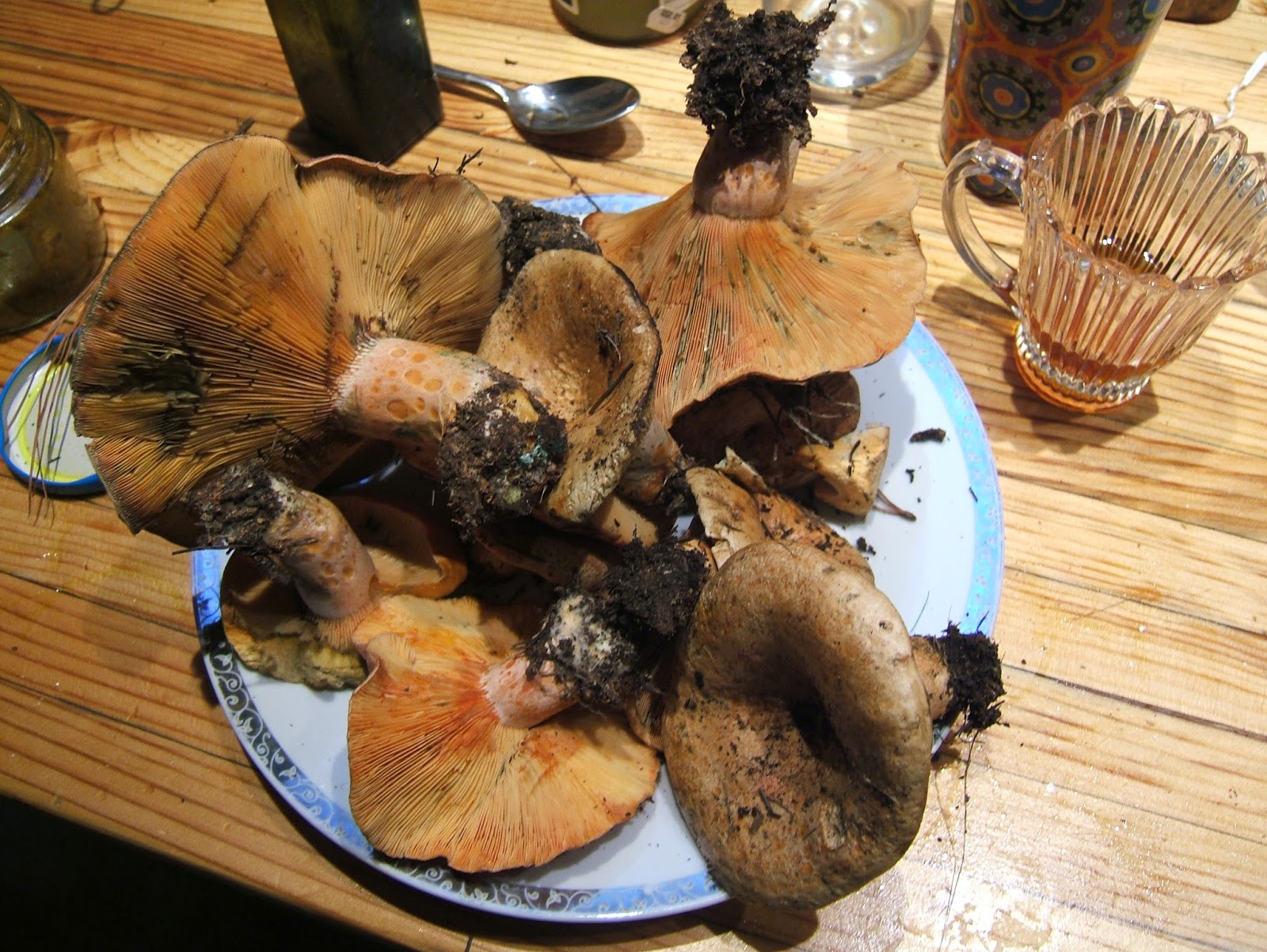
Some mushroom species are quite good for eating, such as these "saffron milkcaps" (Lactarius deliciosus). "Slippery jacks" (Suillus luteus, not shown) are another. The information about which ones you can eat can be passed on from one (living!) mushroom collector to another..
Also, bear in mind that pine trees imported from other parts of the world (Europe, for example) will have mushroom varieties associated with them that have long been prized by European cooks. Let us treasure what has been brought here, where treasuring (and credit) is due.
And of course celebrate the indigenous -- bunya pine -- perhaps even in the same meal!
Monday, 24 March 2014
The Balance of Trees and People

Fifty Eight People and a Tree
(screen print, Joan Drew, 1964)
What is balance -- how does nature achieve this? Let's look at the picture above. I have been inspired by and reminded of this image for many years. We currently have more trees than people on earth (thankfully.. presumably.. hopefully!). So the one in the picture must be quite special. There is a relationship between this tree and the 58 people. It feeds them for example. And they tend it.
So there is human ecology (or Social Ecology) and the ecology of Nature. I'm not sure at what point they diverged, but it is unfortunate that they did. Just as we need diversity of plant species and animal ones -- we need to have human diversity. What if every one was just like me -- or like you (an individual reader)? Just as all trees cannot be radiata pines, we desperately need to have people who look different, act different, sound different, think and feel different and believe differently.
The picture shows a joyous diversity of human types. But the tree! Let us have a few more we might be thinking/feeling right now. How many trees does one person need to have in their mixed human-natural ecology? Quite a few.
It has been written and said that North America and Australia at the time of European arrival had been carefully maintained by the first inhabitants. It was commented that the landscape in both cases had a pleasing park-like aspect. Such that the forests in areas where people also lived were open enough to walk or drive a buggy through. However, following European arrival, untended patches near forests became dense, scrubby, impenetrable jungles, not like they used to be.
Fire was used by the aborigine and native american alike to thin out the undergrowth. This also made it possible for herds of large animals to freely travel through the forested area and thus to be used as game animals. However, it has been found that once the large animals are excluded the landscape suffers. In Africa, herds of elephants were culled and the national parks where they used to live became degraded.
Thus, we find in the grand scheme of Nature/Humanity we have to balance the trees and the people with the large animals. (Whether they be buffalo, kangaroos or elephants.) Interestingly, before the arrival of the aborigine, numerous types of megafauna existed in Australia. The timing of their disappearance was about 2 to 3,000 years after the arrival of humans [based on fossil and geological records]. We could say that they were hunted to extinction. It is likely however that their habitat was altered to the point where they could no longer forage for the type of food they required.
When we alter the habitat of other creatures the consequences can be far-reaching. In Australia, wet rainforests with abundant tree-species diversity (palms and pines included) have been almost universally replaced by eucalypt forests (gum trees). These are adapted to a repeated burning regime (in a way that the rainforests that preceded them never were).
It is not that Australia's landscape cannot support a different mix of tree species than it has now (farms and gardens are ample proof of this), it is just that for historical reasons we have what we have. This includes the human/social/cultural milieu. Whilst it is common to engage in guilt/blame/shame (or the shifting of the above) over what has occurred to trees and people (and animals) in Australia and elsewhere, this is not really a firm foundation or a productive way to build our future. Of course, trying to ignore history does not help. It is all right to acknowledge what has happened and choose a different path.
My sense is that populations of us -- people -- must find a balance within the natural framework of trees and large animals that blanket the continent. It used to be that indigenous people hollowed their dwelling places into the surrounding natural landscape -- rainforest for example. Some still practice a type of agriculture based on rainforest clearings.
This type of foreground/background reversal tends to work better than what is happening in the Amazon today. (But which is the reversal?) Having tiny remnant pockets of rainforest and vast cleared areas for grazing/farming or in some bizarre (but not uncommon) cases -- forestry -- does not seem to be conducive to a healthy ecosystem as a rule. The fifty eight people clustering around a tree is somewhat dystopic in this regard and represents a desperate and undesirable situation if taken too literally (as a real ratio of trees and people).
I have lived in an orchard surrounded by forest and here is what I found. Birds swarm your fruit trees and then return home to the forest to nest. What I have to say about that is this. The type of fruit in that orchard was vastly different to anything the birds would commonly find in their own environment. Of course it attracted them. The buffer zone between raw forest and orchard can be carefully managed however. Let us now talk of solutions!
You could include native/wild fruit species in a buffer zone that you create. This would keep the birds occupied. Also gradually taper and blend one into the other. It is all about proportion. Groves of sacrificial apple trees could merge into the forest margins. You could play with the foreground/background concept. Cultivated fruit trees are harder to find by predators when they blend into the background vegetation, not stand out in the foreground like gilt lettering on an engraved invitation. This is the idea behind a food forest of mixed species -- confuse the predators.
We need to look at natural abundance. One of the things I really wanted to look at in this article was the highly controversial topic of carrying capacity -- particularly in regard to human numbers.
It comes down to rights. Who or what has the right to occupy a given area of land? Do the birds have precedence over me, because I am a newcomer to their land? Do the old rainforest species (palms, pines, etc.) have precedence over the gum trees (now the majority, formerly just one of many species)? Do the new pine plantations take precedence over the vast tracts of gum trees that were here 200 years ago?
Do people from one continent have precedence over any other because they seem to be multiplying more rapidly? Or because they arrived earlier? Who would like to be the one who determines this.
However, if there is balance, what can go wrong? We can achieve a mixture, a blending and an integration. Example. Birds. Tend to raise their offspring in a given area and soon the offspring learn where to find food. It may be your orchard or mine. But if humans also raised their offspring in a given area (such as indigenous people do) they would find the balance with the animal and plant species they co-exist with. Human intelligence could come into play to train the birds to train their offspring not to find food in my orchard (or yours) but another suitable place that had been made for them.
What chance have we of achieving this if we humans have lost our ties to any specific area of land -- drifting rootlessly -- changing habitats stochastically (including myself in this) during any given human lifetime? The early agriculturalists and pastoral nomads as primitive as we might find them (our ancestors) at least had ties to land that spanned generations that we do not have (to anywhere near the same degree).
I am suggesting that human connection to land that spans multiple generations is the best way for us to find a balance with our natural surroundings. We would not want to spoil it then. But look after it beautifully!
Monday, 3 March 2014
The Dachnik Movement -- Changing the World Through Land Ownership -- Illustrated Version

How did Russia manage to find itself in the position of giving land to its people? Well this has been going on for some time. From the 1960's onward, the dacha (a small parcel of land in the country given to citizens) became a part of the Russian way of life. First, under communism, there were strings attached. For example, land was organised through the work-place, one had to have been working at their position (job) for five years, or that land could be forfeit if it was not cultivated. It was not allowed to build anything other than temporary accommodation on the land.


Later in the 1980's, Russia faced major economic and political upheaval. The dacha contributed greatly to the country's food security, and major rioting and widespread starvation were avoided. Land at this time became privately owned without onerous conditions, but was no longer granted for free in the new capitalist regime.


Here are some example of what long-term dacha-dwellers (dachniks) have been able to achieve. A 600 square meter property (the standard size) after 25 years of intensive, loving attention could be transformed into a fertile paradise. No longer weed-strewn and marginal in its productivity, with a smaller number of perennial fruit trees and bushes plus vegetables it could feed a family (some only work on their dachas on weekends). And provide surplus to trade with neighbours and preserve for winter.


Other additional resources that were used during Russia's moment of economic crisis were the nearby forests (mushrooms and berries) and additional land that was used for potato growing. So much so that dacha food productivity far eclipsed commercial cropping for staple food items (potatoes, for example).


It is estimated that 40 million families, or 120 million people (85% of Russia's population) are currently growing food on their dachas. They are supported by 20 magazines, 5 television programs and numerous informative websites and an organisation specifically for dachniks.


Today, the Ringing Cedars movement, based on a series of books by Vladimir Megre, is rekindling the interest of the Russian youth in living on the land, partnering and raising a family under wholesome conditions. The number of kin's settlement villages (made up of individual domains for families, of one hectare) is already in the hundreds. This has occurred in less than two decades since the books were written.

Sunday, 2 March 2014
Kin's Settlements in the Ukraine- update- Russia to give people land !

Link to
Let's look at Russia. Previously I mentioned my interest in the Ringing Cedars of Russia. What this means is a series of books that has become a movement in Russia and elsewhere in the world.

Link to
The big news from Russia THE EARTH NEWSLETTER February 2014 is this. Our brothers and sisters there have worked from the inside out to lobby their government to effect real change. They have included their politicians in their plans for a brilliant future. Also, they have insisted on seeing their elected officials as public servants who represent them. Here's is what's happening.
.jpg)
Link to
(Paraphrase of copyrighted translation)
Vasily Petrov who authored the "Bill on Kin's Estates of Russia" has included the following provisions.
One hectare of land (minimum) to be provided, gratis, to citizens and families in Russia wishing to participate. They may pass on the land as inheritance but not sell it. There is to be no tax on the land, their dwelling or on what they produce on their land. The government may not seize or appropriate the land for its own purposes. The people have the right to amalgamate their holdings into village settlements.
What we have here is the next generation of the Magna Carta, 800 years after! The significance of the above cannot be underestimated. The bill is due to be formalised in July, 2014.
Subscribe to:
Posts (Atom)